


Prevention is the only solution! Watercraft inspection is MANDATORY.
New ordinances in Mono and Inyo Counties require inspections before launching any trailered watercraft, including boats and jet skis, into any body of water.
Trailered watercraft must stop at a Watercraft Inspection & Decontamination (WID) station and receive an Eastern Sierra mussel sticker before launching.
Launching without an inspection may result in fines, misdemeanor charges, and/or boat impoundment.
Resident watercraft (Mono or Inyo County): Inspected once per year before the first launch of the season.
Visiting watercraft: Inspected when entering Mono or Inyo County before launching.
Visiting watercraft inspected in Inyo County or Mono County: That inspection is valid in Mono or Inyo County for the same month.
Any boat that launches outside Mono or Inyo County: Must be inspected again before launching locally.
Wake sport boats with ballast tanks: Mandatory decontamination in Bishop or Crowley Lake Fish Camp.
Please see FAQ below for more information.
WID Stations
Locations, dates, and hours are subject to change! Please check this website again before you visit.
More questions? Please email recreation@mono.ca.gov.
Bishop
Closed for the 2026 season.
However, please call 760-873-0409 between 8 a.m. and 5 p.m. at least 24 hours in advance to request an appointment. LADWP staff will do their best to accommodate appointment requests. Staff are not stationed at the WID and will travel to the site to meet you for your appointment. Please arrive on time. If you do not arrive at your scheduled time, your appointment will be cancelled.
Bridgeport
Location: Bridgeport Ballfields, 1002 Aurora Canyon Road, Bridgeport, CA 93517
Hours: Thursday through Monday from 7:30 a.m. to 3:30 p.m. (Closed Tuesday, Wednesday)
Cost: FREE inspections and decontaminations.
Final day of the season will be October 25, 2026.
This station is closed on Tuesdays and Wednesdays. Please plan accordingly.
We are working to offer appointment-only on these days and will update if that becomes available.
Stop here before driving south of Bridgeport (launching around Lee Vining, June Lake, Mammoth Lakes, etc.)
NO: Wake sport ballast tank boats cannot be inspected and decontaminated at this WID station. Please stop at Crowley Lake Fish Camp.
Crowley Lake Fish Camp
Now open to all watercraft.
Crowley Lake Fish Camp now offers inspection and decontamination for any watercraft, whether or not it is launching at Crowley Lake. A $20 fee applies to watercraft that are not launching at Crowley Lake.
Location: 1149 S Landing Rd, Mammoth Lakes, CA 93546
Hours: Sunday through Thursday: 7:00 a.m. to 9:00 p.m.
Friday and Saturday: 7:00 a.m. to 10:00 p.m.
Cost: Boats NOT launching at Crowley Lake – $20.00
Final day of the season will be October 25, 2026.
YES: Wake sport ballast tank boats can be inspected and decontaminated at this WID station.
Crowley Lake Fish Camp has the specialized, high-capacity decontamination equipment needed for these boats. As a result, wake sport boats planning to launch at Grant Lake or Bridgeport Reservoir may also be decontaminated at Crowley Lake Fish Camp (Bridgeport WID Station cannot decontaminate wake sport boats).
Diaz & Klondike Lakes
These lakes operate their own inspection programs. Inspections at Diaz and Klondike are only for watercraft launching at those locations.
Once inspected, you will receive an Eastern Sierra Mussel Sticker which is valid for launching throughout Mono and Inyo Counties. Inspections completed at Bridgeport, Crowley Lake, or Bishop are also accepted at Diaz and Klondike.
This reciprocity is limited to Mono and Inyo Counties at this time.
Topaz Lake
Topaz Lake spans both California and Nevada, and watercraft launching requirements currently differ between the two states. Because Mono County, California’s Watercraft Inspection and Decontamination Ordinance only applies within California, we cannot require boats launching from the Nevada side of Topaz Lake to comply with Mono County’s inspection requirements.
We encourage all boaters visiting Topaz Lake to help protect it by arriving Clean, Drained, and Dry and obtaining a watercraft inspection and decontamination before launching. Inspections and decontaminations completed anywhere prior to visiting Topaz Lake are appreciated. Free inspections are available at the Bishop and Bridgeport Watercraft Inspection and Decontamination (WID) Stations.
Thank you for doing your part to protect the Eastern Sierra’s lakes and reservoirs. Your time and effort make a difference.
Golden Mussel FAQ
Golden mussels are a serious and immediate threat to Mono County’s lakes, rivers, and recreation. Unlike other aquatic invasive species, they can thrive in our waters—putting nearly all of our local lakes at risk if they are introduced.
This FAQ is here to help you understand what’s changing, what’s required, and why it matters. The new watercraft inspection and decontamination program is a critical step in protecting the places we all care about.
Prevention is our best and only real chance. With a little extra effort from all of us, we can keep these waters clean, open, and thriving for the long term.
Golden mussels are a new aquatic invasive species (to North America) and they pose an even greater risk to Mono County waters than quagga and zebra mussels.
While quagga and zebra mussels require relatively high calcium levels in the water to survive and reproduce, golden mussels can tolerate much lower calcium levels. And no, sadly, our cold temperatures and freezing lakes don’t stop them either.
Golden mussels:
- Attach to almost anything — docks, rocks, boats, motors, pipes, aquatic plants, even muddy lake bottoms
- Survive in a wide range of water temperatures and chemistry, including low-calcium waters like many Eastern Sierra lakes
- Can live outside of water for periods of time
- Reproduce rapidly, spawning multiple times per year and producing thousands of microscopic larvae (called veligers) that are nearly impossible to detect
Unlike quagga or zebra mussels, golden mussels are especially capable of surviving in Eastern Sierra conditions.
If introduced to the Eastern Sierra, golden mussels can:
- Permanently damage lake and stream ecosystems
- Deplete plankton that fish depend on for food
- Threaten recreational fishing, boating, and tourism
- Clog docks, motors, water delivery systems and pipes
- Increase water and power costs due to expensive maintenance
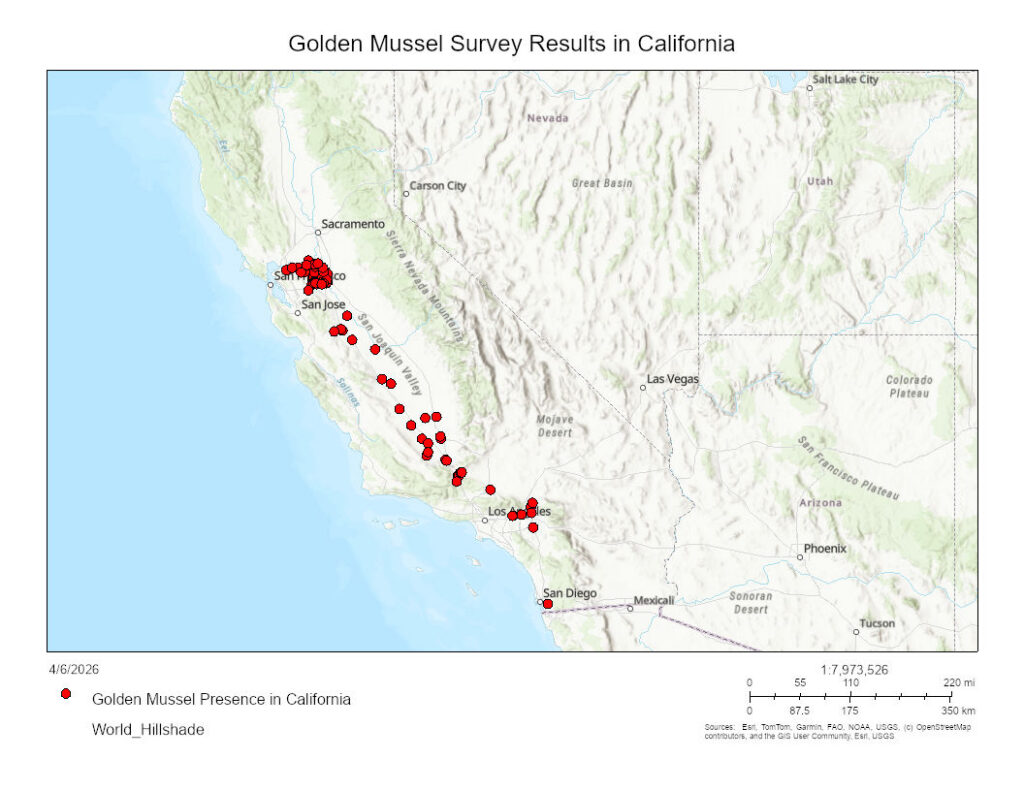
In October 2024, golden mussels were detected in the Port of Stockton. In less than one year, they spread more than 250 miles south.
Our lakes and rivers are highly interconnected. An introduction in one location could spread quickly across the region. Prevention is the only solution.
The entire process – inspection, decontamination, and the stickers (watercraft and trailer) – is free!
→ Resident watercraft (Mono or Inyo County): Inspected once per year before the first launch of the season.
→ Visiting watercraft : Inspected when entering Mono or Inyo County before launching.
→ Watercraft inspected in Inyo County: That inspection is valid in Mono County for the same month. This reciprocity is limited to Mono and Inyo Counties.
→ Watercraft inspected in Mono County: That inspection is valid in Inyo County for the same month. This reciprocity is limited to Mono and Inyo Counties.
→ Any watercraft that launches outside Mono or Inyo County: Must be inspected again before launching locally.
There is no charge for inspection, decontamination (if necessary), or the stickers (one for watercraft, one for trailer).
All trailered watercraft must be inspected before launching in Mono or Inyo County waters. This includes:
- Motorboats
- Jet skis
- Any watercraft transported on a trailer
- Float planes
From the ordinance: “Water vessel” means any trailered watercraft, or jet ski, or float plane capable of being launched into a water body within the County of Mono except as specifically exempted herein. Canoes, kayaks, car- top boats, float tubes, rafts, wind surfers/boards, boogey boards, nonmotorized paddle boats, and nonmotorized sail boats that are eight (8) feet or less in length are not considered water vessels for purposes of this article and are thereby exempt from the provisions herein.
However, there are a few important exceptions not included in the ordinance (at this time). Please do stop for inspection if your watercraft is:
- Are registered with DMV
- Have a trolling motor or other motor attached
- Were recently used in a known infested waterbody
Even when an inspection is not required, all watercraft should still follow the Clean, Drain, Dry principle before launching in Mono County waters.
When in doubt, please ask. We would much rather answer questions ahead of time than risk introducing invasive species into local lakes and rivers.
Wake sport boats with built-in ballast tanks require mandatory decontamination before launching because their ballast tanks, plumbing, pumps, and other internal systems cannot be visually inspected to verify they are completely dry. These enclosed spaces can retain water that may contain microscopic invasive mussel larvae (veligers), even when the rest of the boat appears dry.
Because inspectors cannot confirm that these hidden areas are free of water, decontamination is required to eliminate any remaining water and reduce the risk of spreading invasive mussels to Eastern Sierra waters.
Canoes, kayaks, paddleboards, float tubes, and rafts are generally not required to be inspected*.
That said, there are a few important exceptions not included in the ordinance (at this time). Please do stop for inspection if your watercraft is:
- Are registered with DMV
- Have a trolling motor or other motor attached
- Were recently used in a known infested waterbody
When in doubt, please ask. We would much rather answer questions ahead of time than risk introducing invasive species into local lakes and rivers.
Even when an inspection is not required, all watercraft should still follow the Clean, Drain, Dry principle before launching in Eastern Sierra waters.
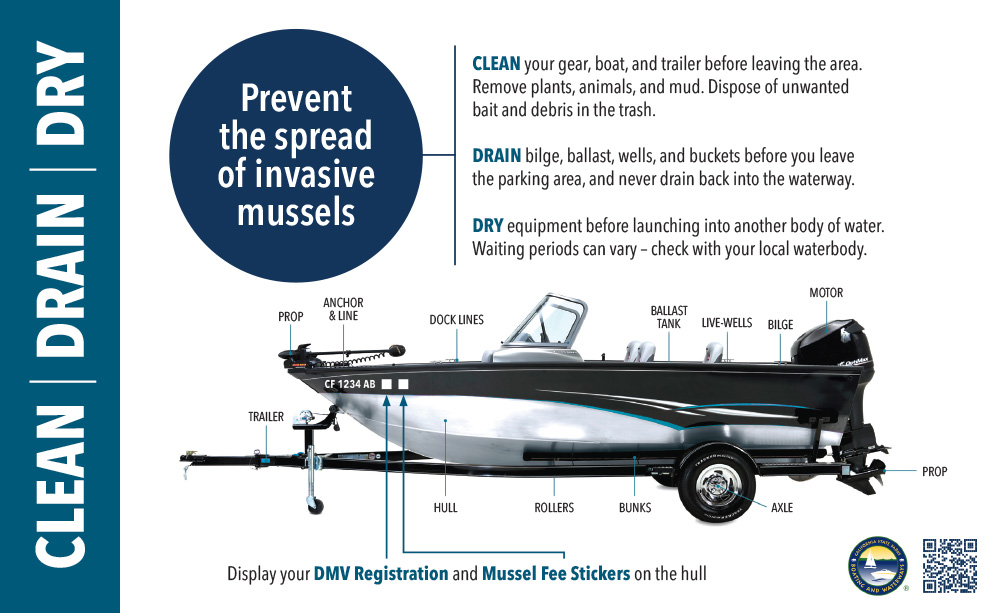
Before entering any waterbody:
- Clean all boats and gear of visible plants and mud
- Drain all water from equipment
- Dry everything thoroughly
These steps help prevent the spread of invasive species and protect Eastern Sierra waters.
*From the ordinance: “Water vessel” means any trailered watercraft, or jet ski, or float plane capable of being launched into a water body within the County of Mono except as specifically exempted herein. Canoes, kayaks, car- top boats, float tubes, rafts, wind surfers/boards, boogey boards, nonmotorized paddle boats, and nonmotorized sail boats that are eight (8) feet or less in length are not considered water vessels for purposes of this article and are thereby exempt from the provisions herein.
Inspection stickers help track when a watercraft was last checked and cleared to launch in Mono and Inyo County waters. The requirements differ slightly for residents and visitors:
Resident watercraft:
- Boats that stay in Mono or Inyo County for the season—whether owned by local residents or kept here through slip rentals, second homes, or extended stays.
- Inspected once per year before the first launch of the season
- Must be re-inspected any time the boat leaves Mono or Inyo County waters and returns
- Please bring proof of registration and/or proof of slip rental to your inspection
Visiting watercraft:
- Inspected upon entering Mono or Inyo County before launching
- Valid for the current month only within Mono and Inyo Counties
- Must be re-inspected if the boat leaves the area and returns—even within the same month
Additional notes:
- An inspection completed in Mono County is valid in Inyo County (and vice versa) for that same month
- Any watercraft that launches outside Mono or Inyo County must be inspected again before launching locally
Yes. Visiting boats must have a valid sticker for the current month. If your sticker expires, you’ll need a new inspection and sticker to continue launching—even if you haven’t left the area.
Inspection stickers are an important tool—but they only work if everyone follows the rules each time they launch. Aquatic invasive species are extremely difficult to detect and remove, and even one missed step can introduce them into our waters. Every inspection is an opportunity for prevention. We truly appreciate everyone doing their part to protect these lakes for the long term.
Mono County and regional partners are actively working to expand watercraft inspection options throughout the Eastern Sierra.
This includes developing an attestation process and working directly with local resorts and marinas to address watercraft that remain in the area, such as rentals and other boats that do not travel outside of Mono or Inyo Counties.
We are also working to secure funding, staffing, and logistics to support pop-up inspection sites in multiple communities, making it easier for residents and visitors to access inspection services.
This is a rapidly evolving effort, and we appreciate your patience as we continue to build and refine these programs to best protect our local waters.
An authorized inspector will:
- Ask a few questions about where your boat has recently been used
- Inspect your boat and trailer for water, mud, or invasive species
This includes checking areas like motors, bilge, livewells, ballast tanks, and any place water can collect.
Inspectors are checking to make sure your boat is:
- Clean (no plants, mud, or debris)
- Drained (no standing water)
- Dry (no moisture that could carry invasive species)
They are also assessing whether your boat has recently been in higher-risk waters.
Short answer: if your boat is wet, it will likely need decontamination.
We know that’s frustrating – especially if it’s just from rain or snow. But the reality is, we have no reliable way to tell the difference between water from weather and water from a recent launch.
Moisture is a problem either way. Even a small amount of standing water can allow invasive species to survive, and our job is to be absolutely sure your boat is clean before it launches.
If you can, letting your boat fully dry or using a cover ahead of time may help avoid decontamination. But if you arrive wet, please talk with staff—we’ll take a look and figure out the best path forward.
We know this isn’t always convenient. Thank you for working with us to get it right..
If your boat is clean, drained, and dry, and does not pose a risk, you will receive an Eastern Sierra Mussel Sticker and can launch.
If your boat is not clean, drained, and dry—or is considered high risk—you will be required to go through decontamination before launching.
Decontamination is a process performed by trained staff using high-temperature, high-pressure water to kill any invasive mussels or larvae.
This is required if:
- Your boat is not clean, drained, and dry, or
- Your boat was recently used in waters outside Mono or Inyo County
You can refuse an inspection, but your boat will not be allowed to launch, and doing so may result in a violation of local ordinance.
Inspection is typically quick (a few minutes). Decontamination may take longer depending on the size and condition of the vessel.
This is prohibited in Mono and Inyo Counties and helps prevent the spread of golden mussels and other invasive species.
Additional Resources
Golden Mussel Information
California’s Invaders: Golden Mussel
Golden Mussel Fact Sheet
Clean, Drain, Dry (& Inspect) – EVERY TIME
See Where & How Quickly Golden Mussels are Spreading Throughout California (click on map):
Local Visitor Info
Mono County Tourism: www.monocounty.org
Mono County Recreation: monocounty.ca.gov/sustainable-recreation
Mammoth Lakes Tourism: www.visitmammoth.com
Town of Mammoth Lakes: www.townofmammothlakes.ca.gov/1147/Office-of-Outdoor-Recreation
Bishop Chamber of Commerce: bishopvisitor.com
Inyo County: inyocountyvisitor.com
CD3 Self-Service Cleaning Stations
Help protect our lakes by cleaning your gear before you launch.
CD3 stations are free, self-service, waterless cleaning stations designed for non-motorized watercraft and recreation equipment like kayaks, paddleboards, float tubes, waders, fishing gear, and other water equipment.
Each station includes a vacuum, blower, hand tools, and lighting to help remove plants, mud, and debris that can spread aquatic invasive species.
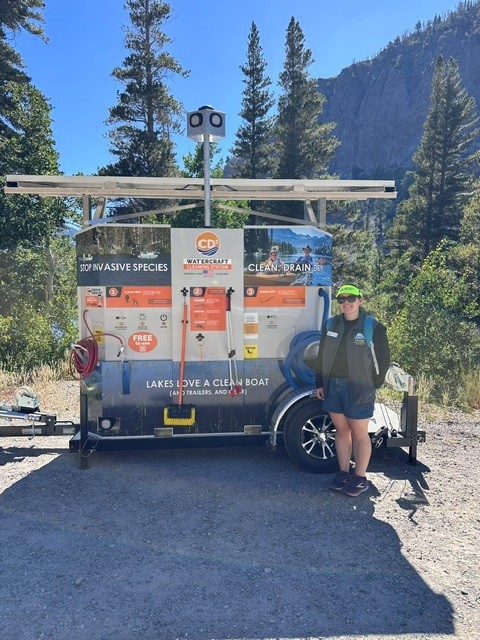
CD3 stations are available in Mammoth Lakes, Convict Lake, and at the June Lake Junction. Use the CD3 map to find the nearest location.
Please note: CD3 stations are not a substitute for required watercraft inspections. Boats and other watercraft that require inspection must still visit an authorized Watercraft Inspection and Decontamination (WID) station before launching.
Tangle Free Waters
Discarded fishing line and hooks can injure wildlife, pets, and people, and they don’t belong in our lakes or along our shorelines. Tangle Free Waters makes it easy to recycle used fishing line and properly dispose of hooks at convenient collection stations throughout the Eastern Sierra. Every piece of line recycled helps protect the places we all love to fish.
Find a Tangle Free Waters recycling station, learn more about the program, volunteer, or even sponsor a tube:
mammothlakesrecreation.org/tangle-free-waters
Responsible Fishing
You’ve made it to the bottom of the page! (Email us at recreation@mono.ca.gov. and tell us you read this website top to bottom, and we will happily mail you a Mussel Monster sticker). Since you’re clearly someone who cares about the Eastern Sierra, here’s a few more ways anglers can help keep the Eastern Sierra’s fisheries healthy and thriving.
Whether you keep your catch or practice catch-and-release, small actions make a big difference. Handle fish with care, dispose of fish waste properly, use barbless hooks when possible, and always leave your fishing spot cleaner than you found it. Together, we can help ensure healthy fisheries for future generations.